Duke University School of Medicine
Durham, NC
Program Director: Peter K. Yi, MD, MSEd
Program Coordinator: LyAshia Webb lyashia.webb@duke.edu
https://anesthesiology.duke.edu/education/fellowships/pain
#dukeanesfellows_pain
#dukepainfellowship

Duke Pain Clinic celebrates the AAPM Pain Fellowship Excellence Award.
Clinical Training Strengths
Clinical settings and patient populations
Fellows train in a wide range of clinical settings, including busy outpatient pain clinics, interventional suites, inpatient consult services, and tertiary/quaternary referral centers. Our patients are diverse and medically complex, giving fellows experience with everything from routine spine care to advanced cancer-related and perioperative pain.
Pain conditions and interventions emphasized
We emphasize comprehensive, patient-centered care for spine pain, neuropathic pain, cancer pain, postsurgical pain, and complex regional pain syndrome. Fellows develop strong skills in multimodal pain management alongside a high-volume, hands-on interventional experience.
Unique or advanced training opportunities
- Close collaboration with the Duke Cancer Institute for cancer and palliative pain care
- Advanced neuromodulation training (SCS, DRG stimulation, intrathecal drug delivery)
- Exposure to perioperative and transitional pain services
- Strong emphasis on ultrasound-guided procedures
Faculty and Mentorship
Faculty distinction
Our faculty are approachable, highly experienced, and nationally recognized leaders in interventional pain, cancer pain, perioperative pain, and medical education. Fellows work closely with faculty who genuinely enjoy teaching and mentoring.
Mentorship structure
Each fellow is paired with faculty mentors based on clinical and career interests. Mentorship is ongoing and informal as well as structured, with regular check-ins focused on growth, goals, and career planning.
Learning environment
The learning environment is supportive, collegial, and collaborative. Fellows are encouraged to ask questions and are given progressive autonomy as skills and confidence grow.
Research and Academic Opportunities
Research and quality improvement
Fellows are encouraged to participate in clinical research, educational scholarship, or quality improvement projects that match their interests and career goals.
Support for scholarship and national involvement
- Faculty guidance with study design, abstracts, and manuscripts
- Support for presentations at national meetings such as ASRA and AAPM
- Opportunities to get involved in medical education, curriculum development, and national committees
Procedural Training

Pain fellows learn the ins and outs of sterile technique.
Image-guided procedures taught
- Fluoroscopy- and ultrasound-guided spine injections
- Radiofrequency ablation
- Sympathetic and peripheral nerve blocks
- Spinal cord and DRG stimulation trials and implants
- Intrathecal pump trials and long-term management
- Peripheral Nerve stimulation
- Reactiv8
- Kyphoplasty
- Intracept
- Osteocool
Hands-on training tools
Fellows have access to simulation-based education, ultrasound workshops, and cadaver-based procedural courses supported by the department.
Career Support and Fellow Outcomes

Fellows receive hands-on suturing practice.
Graduate outcomes
Our graduates pursue a variety of paths, including academic pain medicine, hybrid academic–private practice roles, and high-quality private practice positions across the country.
Career development and board preparation
- Dedicated board review and structured didactics
- Individualized career advising, including practice models and contract guidance
- Strong national reputation and faculty network that supports job placement
Alumni engagement
Alumni stay closely connected to the program and frequently return as mentors, speakers, and collaborators.
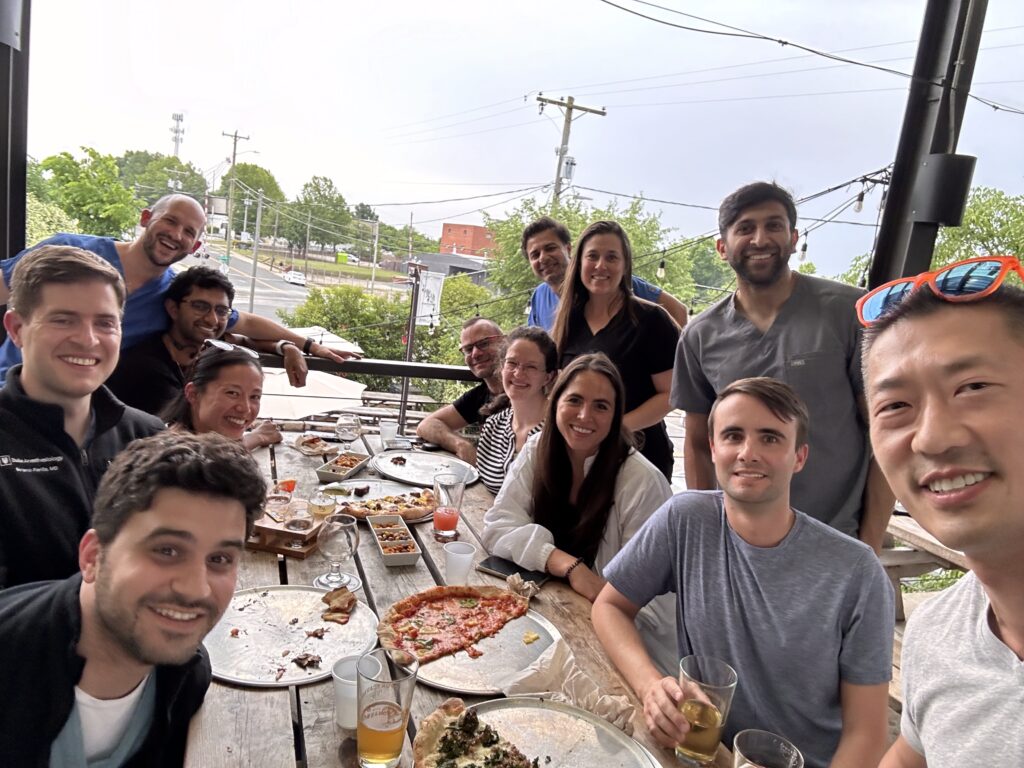
Combined pain and regional fellow case conference outing/dinner
Program Culture and Environment
Program culture
Our culture is welcoming, enthusiastic, and team-oriented. We value clinical excellence, curiosity, kindness, and continuous improvement, and we take pride in training thoughtful, well-rounded pain physicians.
Wellness and work-life balance
- Thoughtful scheduling that supports learning and sustainability
- Access to Duke-wide wellness and mental health resources
- A faculty group that is supportive, flexible, and invested in fellow well-being
Location highlights
Durham and the Research Triangle offer a great quality of life with a reasonable cost of living, outstanding food and coffee scenes, outdoor recreation, and easy access to Raleigh, Chapel Hill, the mountains, and the coast.
Unique features or signature offerings
- Strong integration of pain medicine with innovation in medical education
- Emphasis on leadership development and preparing fellows for long-term career success
- True multidisciplinary collaboration with oncology, surgery, psychiatry, and palliative care